
Thyroid Ultrasound in Warsaw
assessing size, structure and nodules without radiationA thyroid ultrasound helps examine the gland’s tissue, detect nodules and cysts, assess their features and determine whether further workup is needed. At Aurora Medical you can book the exam without a referral. After the procedure you receive a report describing any findings.
Worth knowing
- Ultrasound shows the thyroid’s structure
- Hormonal function is assessed with blood tests
- These tests complement each other
- Price — 250 zł
Book online
What a thyroid ultrasound shows
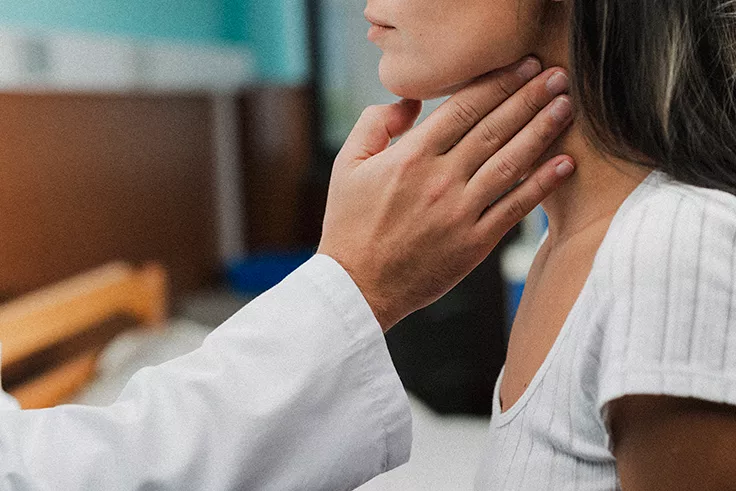
The thyroid gland sits at the front of the neck. During the ultrasound, the doctor assesses its size, shape and structure using sound waves.
- The size of the lobes and isthmus
- The gland’s volume
- Tissue homogeneity and its echogenicity
- The presence of nodules, cysts and other focal lesions
- The size, margins and internal structure of any lesions found
- Blood flow when Doppler mode is used
- Visible surrounding structures and neck lymph nodes
This information helps determine whether observation is enough or further tests are needed.
When a thyroid ultrasound is recommended
The exam is most useful when structural changes of the gland need clarifying.
- An enlarged thyroid was found on examination
- You or your doctor noticed a lump at the front of the neck
- Asymmetry or swelling appeared in the gland area
- A nodule was found incidentally on another test
- A known lesion needs follow-up
- Monitoring is needed after surgery or other treatment, per an individual plan
Be sure to tell your doctor about rapid growth of a lesion, persistent voice changes or difficulty swallowing. These symptoms require clinical assessment and may relate to more than the thyroid alone.
With marked or rapidly worsening breathing difficulty, seek emergency care rather than waiting for a routine ultrasound.
Do I need an ultrasound for fatigue, sleepiness or weight changes
Such symptoms can have many causes. They are a reason to see a doctor, but they do not mean an ultrasound must be the first test.
Thyroid function is usually assessed with a TSH test and, when indicated, other laboratory tests. The need for an ultrasound is determined by the examination findings and the overall clinical picture.
Ultrasound vs hormone tests: what is the difference
A normal ultrasound does not guarantee normal hormone levels. And vice versa: nodules can be found even with normal hormone results.
| Test | What question it answers |
|---|---|
| Thyroid ultrasound | What the gland looks like: size, structure, presence of nodules and cysts |
| TSH and free hormones | How the thyroid is functioning |
| Antibodies when indicated | Whether there are laboratory signs of certain autoimmune processes |
| Nodule biopsy | What cells the lesion contains and what the next diagnostic steps are |
Ultrasound alone cannot establish that the gland produces too much or too little hormone, nor can it be used to adjust a hormone medication dose.
Thyroid nodules: what the finding means
A nodule is an area that differs from the surrounding tissue. The word “nodule” itself does not mean cancer and is not an automatic indication for surgery.
What matters is not only the size but also the ultrasound features, symptoms, previous results and risk factors. After a nodule is found, the doctor may recommend:
- Observation without immediate intervention
- A follow-up ultrasound after a set interval
- Laboratory tests
- An endocrinologist consultation
- A fine-needle aspiration biopsy
The goal of the workup is to determine which changes need further study and which can safely be observed.
How a cyst differs from a nodule
A cyst contains fluid. A nodule may consist mostly of tissue or have a mixed structure — solid and fluid areas.
All of a lesion’s features matter for further management. Risk cannot be judged by a single word in the report.
What EU-TIRADS means
EU-TIRADS is a European system for grading the ultrasound features of thyroid nodules. It helps the doctor choose a monitoring strategy and determine the indications for biopsy. An EU-TIRADS category is not a diagnosis or a cancer stage.
| Category | Meaning |
|---|---|
| EU-TIRADS 1 | No nodular lesions |
| EU-TIRADS 2 | Benign ultrasound appearance |
| EU-TIRADS 3 | Low risk of malignancy |
| EU-TIRADS 4 | Intermediate risk |
| EU-TIRADS 5 | High risk based on ultrasound features |
Even a high category does not replace further diagnostics. The biopsy decision takes into account the lesion’s size, the lymph nodes and other circumstances.
Reports may also use other TI-RADS systems. Their criteria differ, so comparing numbers alone without the system’s name is misleading.
When a thyroid biopsy is needed
“Not every patient with a nodule needs a biopsy.”
It is ordered when the combination of ultrasound features, size and the clinical situation calls for examining cellular material. Suspicious lymph nodes or signs of the lesion spreading beyond the gland can also matter.
In a fine-needle aspiration biopsy, the doctor collects cells from the lesion with a thin needle, usually under ultrasound guidance. The material is sent for cytological examination.
It is a separate procedure: it is not automatically part of a standard ultrasound. If too little material is obtained or the result is indeterminate, a repeat biopsy or another diagnostic step may be needed.
A biopsy recommendation does not mean a malignancy has already been confirmed.
Ultrasound in Hashimoto’s thyroiditis
In autoimmune thyroiditis, ultrasound can show changes in tissue structure, but the diagnosis is assessed together with symptoms, hormone levels and antibodies.
The exam can be useful with an enlarged gland, suspected nodules or when the diagnosis needs clarifying. It is not, however, required for every patient with elevated antibodies.
A repeat ultrasound does not replace monitoring TSH and other tests ordered to assess gland function and treatment.
How to prepare for a thyroid ultrasound
Special preparation is usually not needed.
Yes. A standard thyroid ultrasound requires no fasting. If a blood test or another exam is scheduled at the same time, ask about the preparation for that test specifically.
The ultrasound itself usually requires no stopping of medications. Take your prescribed treatment as usual unless your doctor says otherwise.
Choose clothing with an open neck or an unbuttonable collar. Necklaces, scarves and other items blocking access to the front of the neck need to be removed.
Mention neck tenderness, limited neck mobility, recent surgery and any known reactions to contact agents. If tilting your head back is uncomfortable, say so before the exam: the position can be adapted.
What documents to bring
- Previous ultrasound reports, ideally with images
- Any results for TSH, free T4 and other ordered tests
- Previous biopsy results
- Discharge summaries after surgery or treatment
- A list of your medications
There is no need to order a large set of lab tests on your own just to book an ultrasound. If you have not been tested yet, the doctor will help determine which tests are really needed.
How a thyroid ultrasound works
The exam usually takes around 15–20 minutes. The duration depends on the number of findings and the complexity of the exam; confirm the exact visit length when booking.
Does the ultrasound hurt
A standard ultrasound involves no punctures and is usually comfortable. You may feel the cool gel and slight pressure from the probe.
If your neck is tender, tell the doctor. No recovery is needed after the exam: you can return to your daily activities.
What the ultrasound report contains
The report usually includes the gland’s dimensions and a description of its tissue and any lesions. If nodules are present, their location, size and significant features are listed.
It is useful to compare the new result with the previous one: that lets the doctor assess changes over time.
Individual terms — “heterogeneous structure”, “hypoechoic area”, “cystic component” — describe the image. By themselves they do not determine the need for treatment.
Scintigraphy is not part of an ultrasound. It is a separate test ordered for other indications.
How often to repeat a thyroid ultrasound
There is no universal schedule for all patients. The timing depends on the following factors.
- The nodule’s features and size
- The risk category
- A previous biopsy
- The appearance of new symptoms
- Changes in the lesion over time
- Your individual monitoring plan
Some findings need fairly prompt follow-up, others observation after several years. For some small benign changes, repeat exams may not be needed at all. Follow the specific recommendation in your report.
Is a yearly ultrasound needed without symptoms
A routine “just in case” ultrasound is not mandatory for every adult. Mass screening for thyroid cancer in people without symptoms is not recommended: it can lead to detecting and treating changes that would never have affected health.
With familial hereditary syndromes, past radiation to the neck area or other special circumstances, the plan is discussed individually.
How much a thyroid ultrasound costs at Aurora Medical
No referral is needed to book. Available dates can be checked online or by phone at 884 807 400.
The exam is performed without a referral. The full price list is available on the clinic’s pricing page.
Book onlineWhen booking, ask about
The visit duration; how the report is issued; and whether a separate consultation is included in the chosen service. An ultrasound and a full consultation on treating thyroid conditions may be separate services — if you want to discuss hormone tests or adjust treatment, say so in advance.
Related services: breast ultrasound, full price list.
Packages with a thyroid ultrasound
A package lets you combine several exams in one visit.
The scope of testing is best chosen based on your symptoms and your doctor’s advice: more tests do not always mean a more useful exam.